
Why Eastside Dental Implant Center Delivers Top Implants in IssaquahFrom Your First Visit to Your Final Smile—Here’s Exactly What to Expect
If you’ve been searching for a dental implant dentist near you, you’ve probably run into a lot of vague answers. “It takes a few months.” “You’ll need surgery.” “Results vary.” That’s not good enough, and it’s not how we do things at Eastside Dental Implant Center.
This page walks you through every single stage of the dental implant process, in plain language, so you know exactly what’s coming before you ever sit down in our chair. Whether you’re replacing one missing tooth or considering a full-arch restoration like All-on-X, the roadmap is the same: a personalized plan, precision technology, and a team that’s with you at every step.
The full dental implant process typically takes 6 to 9 months from your first consultation to your final crown. If preparatory procedures like bone grafting are needed, it may be closer to 9 to 12 months. We’ll give you a specific timeline estimate at your free consultation.
Dr. Sidhu and our team serve patients throughout Issaquah, Bellevue, Sammamish, Kirkland, Newcastle, Mirrormont, and the greater Eastside. If you’re looking for a trusted dental implant specialist near you in the Issaquah area, call us at (425) 526-5424 to schedule a consultation.
Why Patients Choose Eastside Dental Implant Center for Dental Implants Near Them
There’s no shortage of dental offices in the Issaquah area. So why do patients from Bellevue, Sammamish, and Kirkland drive past closer options to come to us?
Because implants are not a commodity procedure. Precision matters. Experience matters. And the technology in the operatory matters enormously.
Here’s what sets our implant practice apart:
- Specialized implant training. Dr. Sidhu’s focus is implant dentistry—this isn’t a general dentistry office that “also does implants.” Every case, every day, is implant work. That level of focused repetition produces results that generalist practices simply can’t match.
- 3D cone beam CT imaging (CBCT). Before we place a single implant, we map your jaw in three dimensions. We can see bone density, nerve pathways, sinus cavities, and the exact trajectory each implant needs to follow — all before you’re in the surgical chair. This is now considered the clinical gold standard for implant planning, and it’s how we eliminate surprises.
- Digital treatment planning and surgical guides. Using your CBCT scan, we design a custom surgical guide — a 3D-printed template that directs the implant to its exact planned position during surgery. This is called guided implant surgery, and it means smaller incisions, less tissue disruption, faster healing, and predictable outcomes.
- State-of-the-art titanium implant systems. We use implants with advanced surface coatings designed to accelerate osseointegration — the process by which your jawbone bonds to the implant. The surface science matters: nano-textured implant surfaces bond to bone faster and more reliably than older smooth-surface designs.
- All solutions under one roof. Single-tooth implants, implant-supported bridges, All-on-4, All-on-6, snap-in dentures—we handle the full spectrum so you’re never referred out for pieces of your own treatment.
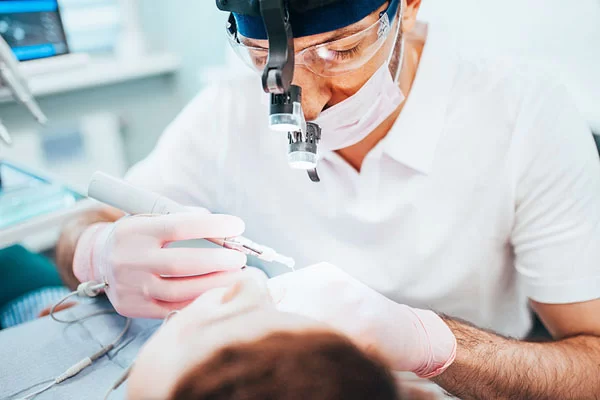
The 7-Step Dental Implant Process at Eastside Dental Implant Center
Every implant case is unique. But the process follows a predictable, evidence-based sequence. Here’s what that looks like from start to finish.
Step 1: Comprehensive Initial Consultation
Your implant journey starts with a conversation—and a thorough look at what’s actually going on in your mouth.
During your first visit, we conduct a full diagnostic evaluation using digital X-rays and, where needed, a 3D cone beam CT scan. This gives us a complete picture of your jawbone volume and density, gum tissue health, the position of surrounding teeth, nerve and sinus structures that affect implant placement, and your overall oral health status.
We also talk. We ask about your medical history, any medications you’re taking, whether you smoke, and what your goals are. Implants touch every corner of your oral health and general health, so nothing is too small to mention.
By the end of your consultation, you’ll know whether you’re a good implant candidate, whether any preparatory procedures are needed, and what a realistic timeline looks like for your specific case.
There’s no obligation at this stage. We believe an informed patient is a confident patient—and confident patients get better outcomes.
Step 2: Personalized Treatment Planning
After your evaluation, we build your custom treatment plan. This isn’t a template pulled from a drawer—it’s a plan designed around the geometry of your jaw, your aesthetic goals, your health history, and your life.
We’ll determine the number and location of implants needed, the optimal implant system for your bone density and bite, whether any preliminary procedures are required before placement, your anesthesia and sedation preferences, and a full timeline from surgery through final restoration.
We’ll also walk through your financing and insurance options at this stage, so there are no financial surprises later. Dental implants are an investment, and we want you to understand exactly what that investment looks like before committing to anything.
If you’re anxious about the process, this is the time to say so. We offer sedation options and will explain every step in detail so you feel prepared, not nervous, on surgery day.
Step 3: Preparatory Procedures (When Needed)
Not everyone needs preliminary work before implants — but some patients do, and it’s important to understand why.
- Bone grafting. Implants need a solid foundation of jawbone to anchor into. When bone has been lost due to tooth loss, gum disease, or injury, grafting is required to rebuild that volume. We place bone graft material at the implant site, and over the next few months, your body integrates it into your own bone structure. Without adequate bone, implants fail — which is why we won’t skip this step even if it extends the timeline.
- Sinus lift. The upper back teeth sit close to your sinus cavities. When those teeth are missing, and bone volume has decreased, a sinus lift procedure creates the space needed for implants without encroaching on the sinus floor. It’s a specialized procedure, and it’s one we perform in-house.
- Tooth extraction. If a failing or damaged tooth is still present, it’s removed before or at the time of implant placement. In some cases, an implant can be placed in the same appointment as extraction—ask us if you’re a candidate for this approach.
- Periodontal (gum) disease treatment. Healthy gums are a prerequisite for successful implants. Active gum disease creates a bacterial environment that significantly increases implant failure risk. If we detect gum disease, we treat it before placing any hardware.
Step 4: Implant Surgery
Surgery day is usually more uneventful than patients expect—and that’s by design.
Before we begin, you’ll be completely numb via local anesthetic. If you’ve opted for sedation, you’ll be relaxed and comfortable throughout. We place the titanium implant post, which serves as the new tooth root, directly into the jawbone at the precisely planned location. Using our surgical guide, placement is accurate to within a fraction of a millimeter.
The procedure is minimally invasive. Our technique involves small, carefully placed incisions rather than broad flap surgery, which means less post-operative swelling, less discomfort, and faster recovery for most patients.
After placement, we provide detailed post-operative instructions, prescriptions for any antibiotics or pain management needed, and a direct line to reach us if you have any concerns during healing.
Most patients are comfortable returning to desk work within a day or two. Physical activity should be limited for about a week.
Step 5: Osseointegration — Your Body Does the Work
After surgery, the real magic happens—and it happens slowly, quietly, inside your jawbone.
Osseointegration is the biological process by which your bone cells grow into and fuse with the surface of the titanium implant. Over 3–6 months, the implant becomes structurally integrated with your jaw—not sitting in bone, but part of it. This creates a root that’s actually stronger than the original tooth root it replaced.
You’ll be given a temporary restoration during this period so your smile stays intact. You’ll follow a soft food diet for the first several weeks; attend periodic check-up appointments so we can monitor healing; and avoid anything—smoking, hard foods, or trauma to the area—that might disrupt the process.
Modern implant surface technologies have meaningfully shortened osseointegration timelines compared to implants from a decade ago. Nano-textured and calcium-phosphate-coated surfaces create more sites for bone cell attachment, which speeds up integration. We use implant systems that incorporate these advances.
Once osseointegration is complete—confirmed radiographically—we move to the restorative phase.
Step 6: Custom Crown Design and Fitting
The implant post is the root. The crown is the tooth. And getting the crown right is just as important as getting the implant placement right.
We take digital impressions of your bite and the implant site—no uncomfortable putty molds. These scans feed into a digital design workflow that produces a crown matched precisely to the shape, size, and shade of your natural teeth. The goal is a restoration that’s indistinguishable from what nature gave you.
We schedule fitting appointments to check the crown’s fit, bite alignment, and appearance before finalizing everything. You’ll have input on how the final result looks.
Step 7: Final Restoration and Long-Term Success
When everything is confirmed and your bite is dialed in, your permanent crown is secured to the implant abutment. This is the finish line.
We’ll go over your care routine in detail—what to use, what to avoid, and how often to come in for professional maintenance. With proper care, dental implants routinely last 25 years or more. Many last a lifetime.
You’ll leave with a fully functional, natural-looking tooth—and the confidence that comes with knowing it’s built to stay.

How Long Does the Dental Implant Process Take?
This is the question we hear most, so here’s a direct answer:
| Scenario | Estimated Timeline |
| Straightforward single implant | 6–8 months |
| Implant requiring bone graft | 9–12 months |
| Full-arch (All-on-X) without grafting | 3–6 months |
| Full-arch (All-on-X) with grafting | 9–14 months |
The majority of that time is healing—osseointegration and bone graft maturation—not active treatment. Most patients are surprised by how few actual appointments are involved and how manageable the process is day-to-day.
Caring for Your New Dental Implants
The First Few Weeks After Surgery
The first two weeks set the foundation for long-term success. Here’s what to do:
- Stick to soft foods—think smoothies, mashed potatoes, scrambled eggs, soup, and yogurt.
- Avoid anything hot, spicy, crunchy, or chewy.
- Brush gently around the surgical site using a soft-bristled toothbrush.
- Avoid smoking and alcohol entirely—both impair blood flow to healing tissue and dramatically increase the risk of implant failure.
- Use prescribed medications as directed and apply ice packs to the jaw during the first 24–48 hours to manage swelling.
If you experience prolonged bleeding, worsening pain after day three, or signs of infection (fever, pus, or unusual swelling), call us immediately at (425) 526-5424.
Long-Term Implant Maintenance
Implants don’t get cavities, but they can fail if the surrounding gum tissue becomes infected (a condition called peri-implantitis). The dental implant maintenance routine is straightforward:
- Brush twice daily with fluoride toothpaste and floss daily around both the implant and natural teeth.
- Use an interdental brush or water flosser to clean around the implant base.
- Attend professional cleanings every six months and avoid biting down on ice, hard candy, or non-food objects.
With this routine, your implant should outlast most things you own.
Frequently Asked Questions
Most patients are surprised by how manageable it is. During surgery, a local anesthetic ensures you feel nothing. Post-operatively, most people describe discomfort as mild to moderate — comparable to a tooth extraction — that peaks at around 48 hours and improves steadily from there. Over-the-counter pain relievers are usually sufficient; we’ll prescribe something stronger if needed. If you’re anxious, ask about our sedation options — you can be completely relaxed from start to finish.
A single dental implant in the Issaquah and greater Seattle area typically ranges from $3,500–$6,000 depending on the complexity of your case, whether bone grafting is required, and the type of restoration used. Full-arch solutions like All-on-X involve different pricing structures. We provide a detailed cost breakdown at your consultation and work with most major insurance plans. We also offer flexible financing options — ask about CareCredit and other payment plans.
For the first two weeks: soft foods only. Think smoothies, yogurt, mashed potatoes, oatmeal, eggs, soft fish, and soup. From weeks three through the end of osseointegration: gradually reintroduce softer regular foods but continue avoiding anything hard or crunchy. After your final crown is placed, you can eat almost anything — that’s the point of implants. The one ongoing caveat: avoid biting down on very hard objects (ice, hard candy, pen caps), which can chip even natural teeth.
This is one of the most common concerns we hear—and it almost never means implants are off the table. Bone grafting procedures rebuild the volume needed to support an implant. Depending on the degree of bone loss, grafting can range from a simple socket graft (often done at the same time as extraction) to a more involved procedure using your own bone or high-quality synthetic material. We assess your bone volume at your consultation and tell you exactly what’s needed.
Some patients are candidates for immediate placement, where an implant is placed in the same appointment as a tooth extraction. Whether you qualify depends on your bone density and the reason for extraction. True “teeth in a day” full-arch solutions like All-on-X can provide a functional temporary arch on the day of surgery. We’ll tell you at your consultation whether either of these options applies to you.
Most adults in good general health who have one or more missing teeth are candidates. The primary requirements are adequate jawbone density (or the willingness to do grafting), healthy gum tissue, and no uncontrolled systemic conditions that impair healing (like uncontrolled diabetes). Smoking increases risk but doesn’t automatically disqualify you. Age isn’t a barrier — we routinely place implants in patients in their 70s and 80s. The only way to know for certain is a proper evaluation, which we offer at no charge.
When properly placed and cared for, dental implants have a success rate of 95–98%. Most implants last 25+ years; many patients keep theirs for life. The crown attached to the implant may eventually need replacement after 15–20 years due to normal wear, but the titanium implant post itself is built to be permanent.